
Thoughts on Mark Fisher’s Book “The Cancellation of the Future”
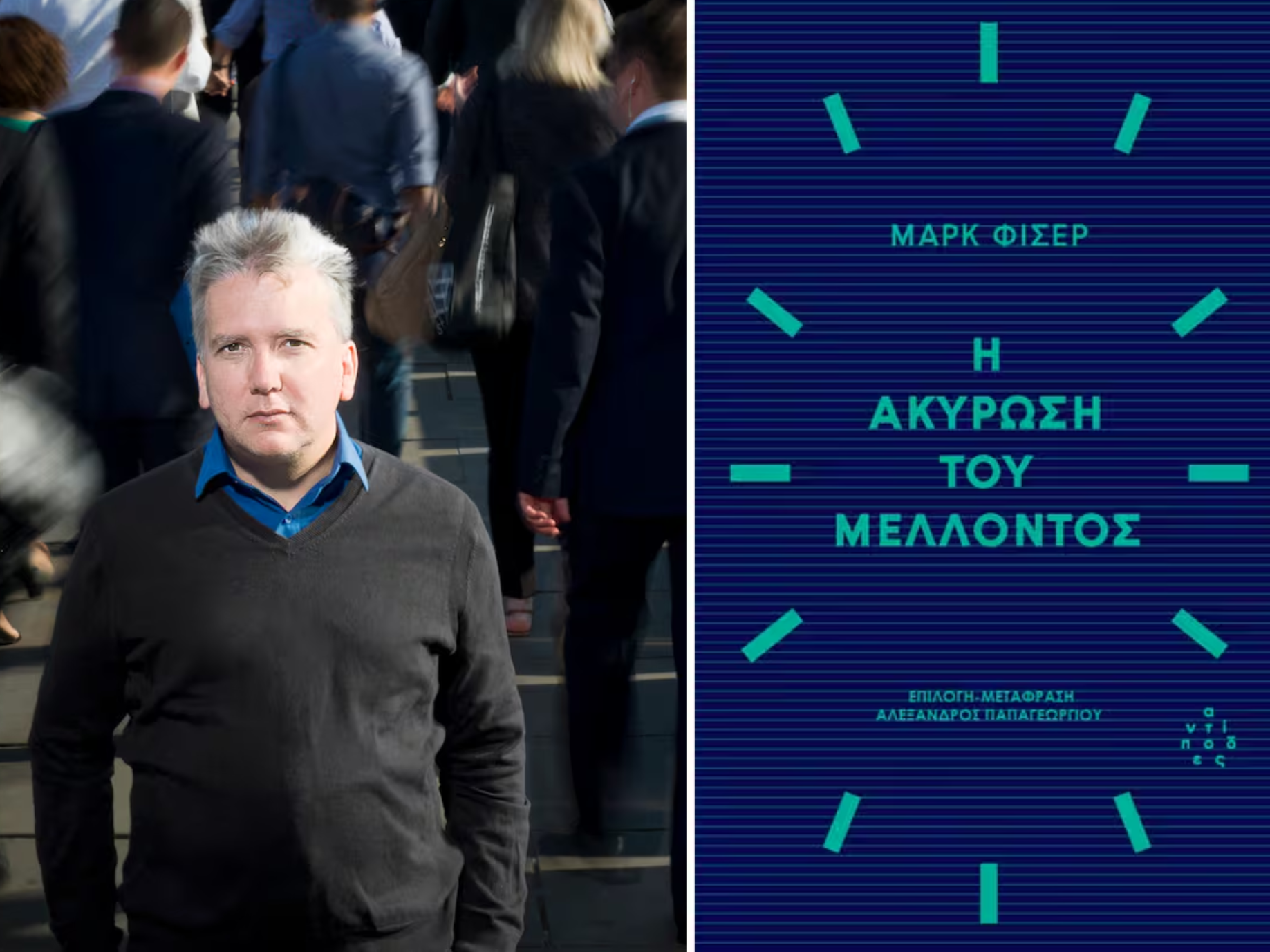
Thoughts on Mark Fisher’s Book “The Cancellation of the Future”, (selection-translation: Alexandros Papageorgiou), ANTIPODES, 2024.
By Helena Maousidi – Zirganou
“The Cancellation of the Future” is not a single work, but a collection of texts that connect social and political reality with contemporary culture. What we consider to be the most interesting part of the book and resonates with our own concerns and positions concerns the way in which capitalist realism [1] affects mental health.
In the chapter entitled “The Privatization of Anxiety”, Fisher discusses the social and political dimension of mental symptoms and distress, which within the framework of the capitalist system and neoliberal culture are marginalized, individualized and depoliticized. Characteristic, moreover, is the insistence of modern psychiatry and psychology on the attribution and justification of mental symptoms based on neurological terms.
Recruiting important authors, such as Dan Hind (2010), he states that the focus on serotonin deficiency as a cause of depression obscures the social dimensions of distress. This is where multinational pharmaceutical companies come to the rescue, since it seems easier to prescribe drugs than to completely change the way society is organized. At the same time, there are many mental health professionals who preach the gospel of achieving happiness through a few simple steps.
On the one hand, we believe that the pharmaceutical industry contributes to the privatization of anxiety, but also to the individualization of mental symptoms. On the other hand, equally important are the innovative holistic practices that depoliticize mental distress. Following on from this critique, David Smail (2005), who is often cited in the book, argues that contemporary therapeutic approaches are now permeated by the Thatcherite view, that there is no society, only family and individuals. What Smail (2005) claims and supports concerns the social dimension of psychological distress, that is, that the substitution of the collective gaze for individual biographies leads to forgetting that “the so-called ‘inside’ is in reality a refolding of the outside. Most of what is supposed to be ‘inside’ of us, we have in reality acquired from the wider social field” (p. 104).
The common starting point and component of Fisher’s concept with that of the Group Analytic Approach adopted at the Open Psychotherapy Centre cannot remain unmentioned. The theory and therapeutic method of S.H. Foulkes primarily emphasize the sociological and psychological observation that each individual is shaped and determined by the group and community of which he is a part, that is, by his social relations (Foulkes, 1948, p. 10). By analogy, mental illness is a product of the disturbed relationship of the individual with his social network, with the result that healing occurs through the normalization of this relationship.
To summarize in Fisher’s words, “when can talking about our feelings become a political act? When it is part of a practical collective awareness that makes visible the impersonal and intersubjective structures that ideology usually obscures” (p. 106). In short, the recognition of the social dimension of discomfort and its group/collective processing constitutes a political act.
Mark Fisher (1968-2017) was born in Leicester. He was a writer, political philosopher, cultural critic and blogger, best known for his book Capitalist Realism (Futura, 2015). The writing on the k-punk blog on music, film, pop culture, etc. was crucial to the radical cultural discourse of an entire generation.
[1] Capitalist realism: this is a term that refers to the widespread belief that there is no alternative to capitalism – although the term belief is potentially misleading, given that the logic of capitalist realism manifests itself in institutional changes in workplaces and media, but also nestles within people’s minds (p. 57).