
Open Psychotherapy Centre
Chairman of the Board of Directors: Efthymios Th. Markezinis
The Open Psychotherapy Center was founded in February 1980 by a group of people directly interested in the mental health and was the practical expression of a series of disagreements, findings, but also positions in the Greek psychiatric field. More specifically, “its creation was decided after it was established that state programs, even the most expensive ones, not only do not solve, but on the contrary complicate the mental health problem, since they almost always result in the alarming proliferation of private or state beds, in the increase in the turnover of pharmaceutical companies, as well as, most importantly, in the increase in psychiatric patients” (Tsegos, 1981).
Psychotherapy and Training in a Day Center
The organization’s founding statute states the following main objectives:
- Creating appropriate working conditions, both for the patients and mainly for the therapists.
- Demystifying the dangerousness of the mentally ill.
- Promoting psychotherapy on a daily basis as the main therapeutic approach.
- Reasonable use of medications.
- Debunking the myth that psychotherapy is expensive. On the contrary, it can be accessible to all social classes.
- Training of mental health professionals in psychotherapy (Group Analysis, Psychodrama-Socioherapy, Family Therapy) and Psychological Assessment.
- Raising public awareness of the idea of the community approach.
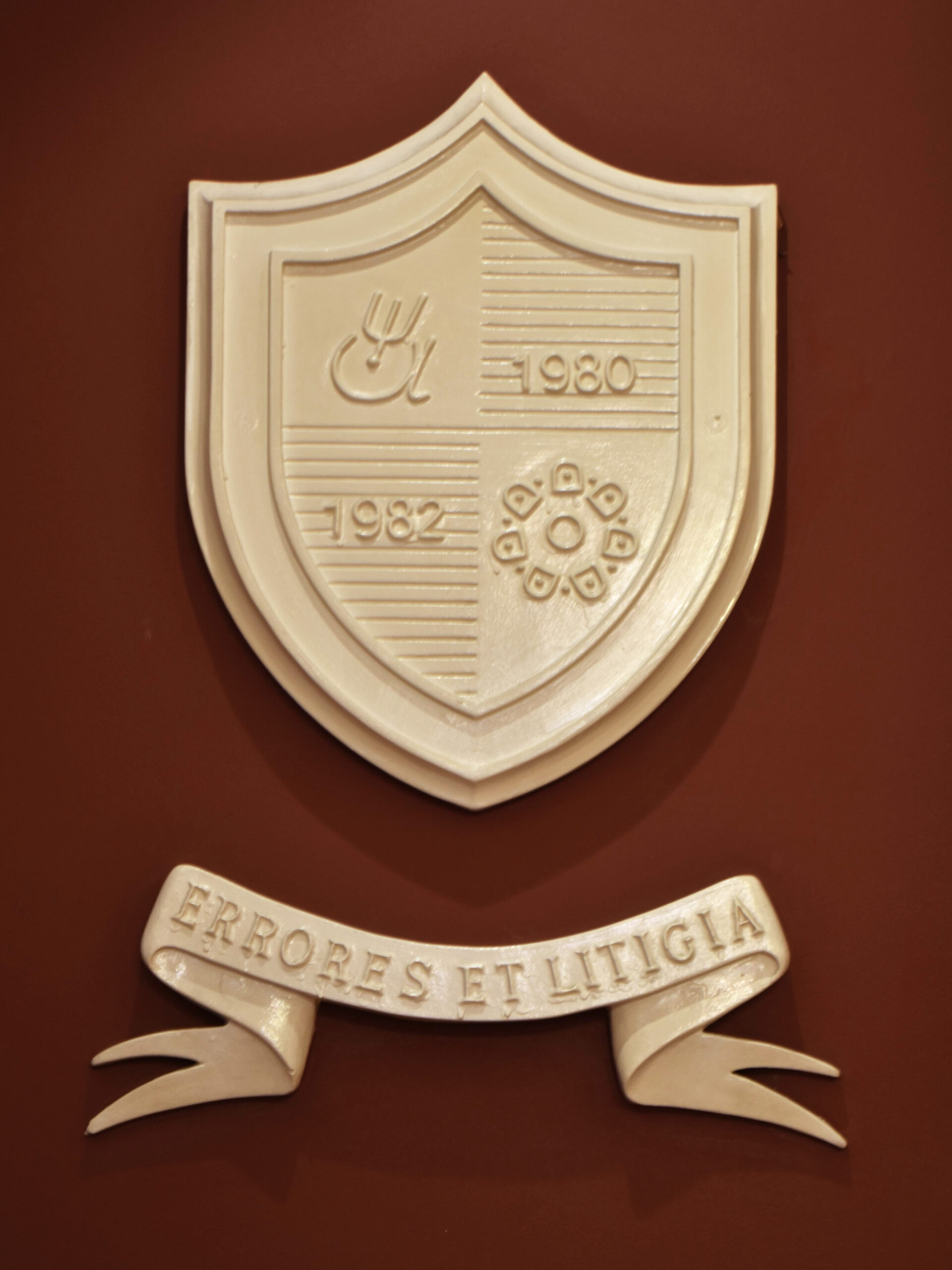
In the photo, the motto of the Center and the IOA “Errores et Litigia” (Mistakes and Disputes)
Innovations
By adopting in-person psychotherapy from the very beginning, we have applied the rarely followed principle of intensive clinical practice harmonized with training. The co-location of the Institute of Group Analysis with the Center, and the continuous intertwining of therapeutic and training activities, brought about many revisions, reversals and innovations, both practical and theoretical, in the practice of therapy and training, such as:

Establishment of the Multifactorial Assessment and the Multifactorial Therapeutic Approach according to the needs of a specific patient. Inclusion of the Psychological Assessment of Personality in the diagnostic period, together with the detailed taking of the History, the Psychiatric Assessment and the Family Assessment.

Critical reappraisal of Group Analysis and Therapeutic Community and highlighting both as therapeutic procedures appropriate for serious psychiatric disorders.

Original psychotherapeutic approaches: Group-Analytic Model of Psychotherapeutic Community, Group-Analytic Psychodrama, Fortnightly Psychotherapeutic Community, Psychodrama for Young Adults, etc.

Emphasis on Unstructured Activities – Intervals – Means. Such activities or situations are considered, for example: the time between sessions, the random or agreed-upon meetings between patients, between therapists and patients, or between trainers and trainees.

Definition of therapy: “Anything that one attempts to get rid of something or to change something. This is attempted either alone or with the help of one’s own (people), or with the help of experts. The key word here is “with” “together” (Tsegos, 1987, 2002, p. 76). After all, according to S.H. Foulkes “psychotherapy is done by the group, for the group, including the conductor”.

Distinction of collectivism from communalism in the field of clinical practice. Collectivism is characterized by the control of the common living and working environment, as well as by the common sleeping and eating together. In contrast, communalism is distinguished by the participation of all in making decisions concerning its operation, its preservation and its particular culture, but also by the privacy and particularity of personal living (home, family, etc.).
Common sense can be easily cultivated and thrive comfortably within the Community environment, providing an antidote against nonsense, but also against the development of mechanistic and reductionistic thinking, thus dispelling the rationalistic and intellectualist beliefs, which are easily cultivated in psychotherapy, as well as in other altruistic professions.
Humor. It is considered a natural, healthy and necessary element of the psyche of all those involved in the psychotherapeutic process, as well as a powerful antidote to any pathology.
The personal focus on the dream, that is, the approach of any spontaneously expressed dream material, exclusively as a personal way of expression of each individual and not as a product enriching the argumentation in support of theories, through uncontrolled hermeneutics. The interpretation of the dream is left to the jurisdiction of the dreamer and secondarily to the therapists and other co-treatees.
In its 45 years of operation, the O.P.C., as a political intervention in psychiatry and psychotherapy, has accomplished much more than it had planned, aspired to, or envisioned.
THE SECTORS AND THE DEPARTMENTS
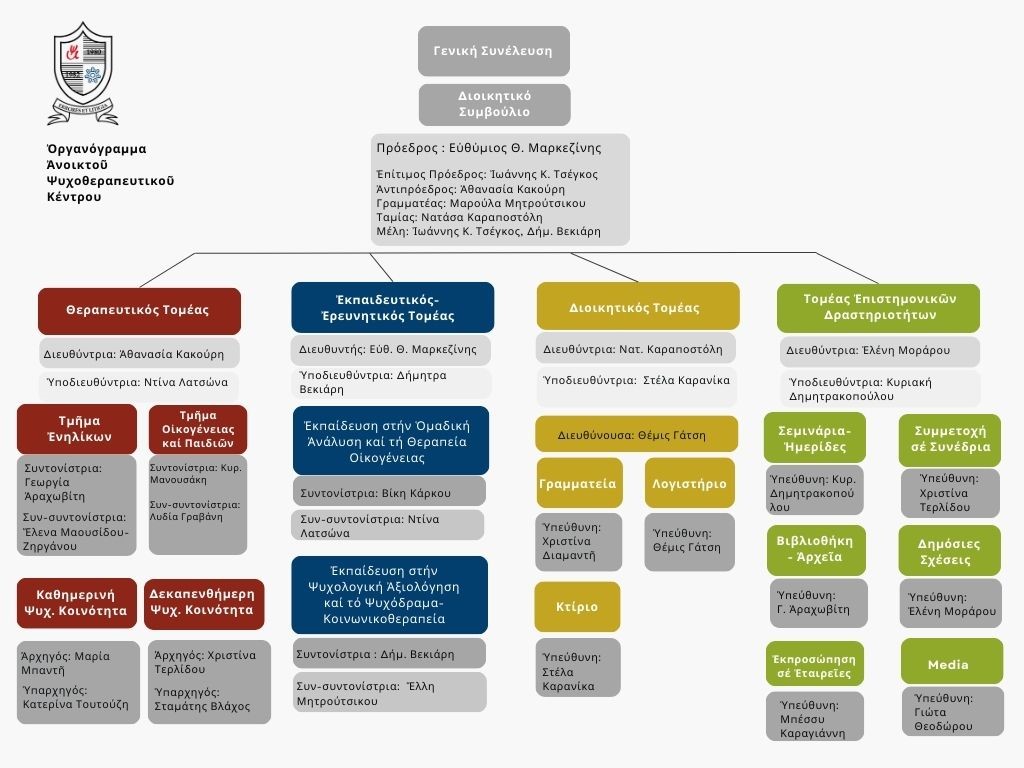
Board of Directors: President Efthymios Th. Markezinis, Honorary President Ioannis K. Tsegos, Vice President Athanasia Kakouri-Basea, Secretary Maroula Mitroutsikou, Treasurer Natasa Karapostoli, Member Dimitra Vekiari
Therapeutic Sector: Supervises the therapeutic activities (Adults, Children-Adolescents, Families-Couples and Psychotherapeutic Communities)
Director: Athanasia Kakouri-Basea
Deputy Director: Konstantina Latsona
Training – Research Sector: Supervises the Postgraduate Trainings and Research in collaboration with the Institute for Group Analysis, Athens
Director: Efthymios Th. Markezinis
Deputy Director: Dimitra Vekiari
Scientific Activities Department: Supervises scientific events (Workshops, Conferences, Lectures), Publications, Editions, the Library and Public Relations.
Director: Eleni Morarou
Deputy Director: Kyriaki Dimitrakopoulou
Administrative Sector: Supervises the operation of the administrative services (Finance-Accounting, Secretariat, Building Maintenance, Archives, External Collaborators)
Director: Natassa Karapostoli
Deputy Director: Stella Karanika
Communal Approach to Coordination of Sectors and Departments
The Center has adopted the Communal Approach in its organization and administration with the aim of facilitating its work, utilizing both small and large groups. The aim is to develop good relationships and personal interest, as well as open communication, vertical and horizontal, in the functioning of the Organization.
The Sectors, as well as the Departments, have their Directors/Conductors, who rotate periodically, so that as many of the associates as possible have this opportunity. Each Department maintains its autonomy, with the participation of all staff members, collaborators and trainees. Its decisions, needs or proposals are announced and discussed or modified in the monthly Coordinating Meeting, which is composed of the conductoes of all departments.
Issues concerning the general policy are discussed and decided by the Board of Directors, which meets 2-3 times a year. The Board of Directors generally oversees the maintenance of the decentralized nature of the procedures, the finances (budgets etc.) and represents the Center externally.
Secretariat
The Secretariat belongs to the Administrative Sector and is a key point of the organization. All the activities of the Center are carried out thanks to the four-member Secretariat staff, which, among other things, also supervises the maintenance of the building. The financial management is carried out by a part-time accountant as well as a member of the Secretariat, under the supervision of the Board of Directors.
Therapeutic Sector: Theodora Vana
Educational-Research Sector: Christina Diamanti
Accounting: Themis Gatsi, Giannis Dontis

Cookie Consent
This website uses cookies to optimize your browsing experience!
Help us understand how visitors interact with our website.
While we don't currently use advertising, your consent is required for regulatory compliance.
We don't share user data for advertising purposes, but your choice is required for GDPR compliance.
We don't display personalized ads, but your choice is required for future GDPR compliance.