
The Psychoanalytic Movement
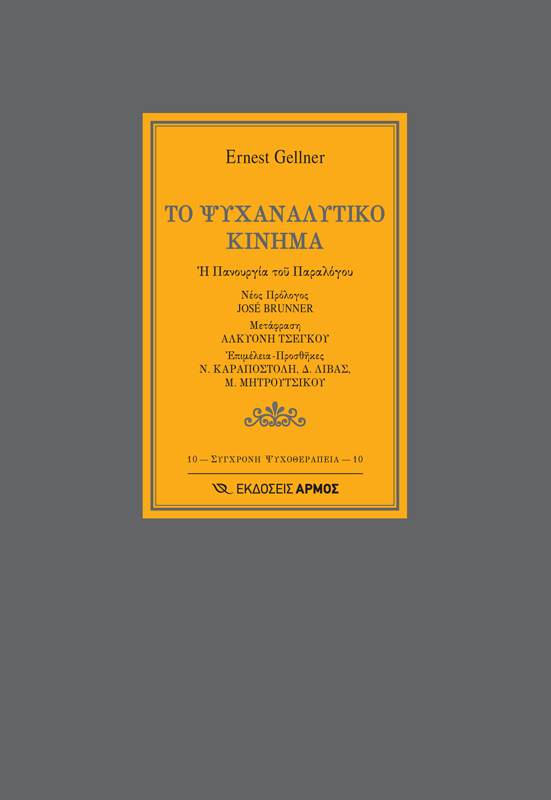
The Psychoanalytic Movement. The Cunning of the Unreason. Ernest Gellner, 1975, Translation: Alkyoni Tsegkou. Edited by: Natasha Karapostoli, Dimitris Livas, Maroula Mitroutsikou. Athens: ARMOS Publications, 2015.
From the back cover:
Gellner, a philosopher and social anthropologist, was a prolific writer. He wrote about freedom, the nation, nationalism, and Muslim society. In this book, he deals with Psychoanalysis, which occupied him for a number of years. According to Brunner, it is very difficult to find a clearer and sharper writer, who possesses a unique style and the exceptional charisma that enables him to avoid pompous phraseology, to focus precisely on the subject and to present his point of view, however complex, with clarity and witty humor.
According to the author, the purpose of the Psychoanalytic Movement is to offer an appreciation of how, in less than half a century, this system of ideas managed to conquer such a large part of the world, and to such an extent that it now constitutes the dominant idiom in the discussion of personality and human relations. Gellner attempts to achieve this by connecting the central ideas and practices of the system with the most important social and intellectual changes of the era.
He considers psychoanalysis as a secular religion, a system of belief, a successor state to the pastoral role that the church had in the past, capable of securing a multitude of followers and offering a kind of secular redemption. He looks back at the most important currents of ideas of the era (Renaissance, Enlightenment, Marxism, etc.) comparing them with Freudism. He states characteristically: Freudism was different. From the first moment, it contained a certain tendency towards political complacency. Salvation lies in adaptation, a term that depth psychology essentially introduced into the ethical vocabulary of modern man. He implicitly or explicitly preached the acceptance of the social system, something which, ultimately, caused some embarrassment during the Hitler period (should this regime also be accepted by the man who had “found out about himself”?).
With his biting style and phlegmatic humor, he formulates sayings such as:
If analysis were effective, the Japanese would have adopted it long ago, and would have flooded the world market with cheaper, faster and more effective analyzers.
Imagination is the cure and not the disease.
CONTENTS
Note from the I.K. Tsegou
PROLOGUE by Jose Brunner
ACKNOWLEDGEMENTS
INTRODUCTION to the second edition
Return to Nature
The Scourge
The Influence of Pirandello
On the Wheel of Torture
The Cunning Mediator
The Recovered Reality
The Urbanization of the Soul
The Anatomy of a Faith
The Limits of Science
The Imagination Therapy
APPENDIX A
BIBLIOGRAPHY
INDEX
Παρουσίαση τοῦ βιβλίου, , “The Psychoanalytic Movement. The Cunning of the Absurd” by Ernest Gellner, at ARMOS Publications, on Saturday, March 28, 2015.
Presented by: Theodoros Ziakas, author, Spyros Koutroulis, author, Ioannis Tsegos, Director of the “Contemporary Psychotherapy” Series