
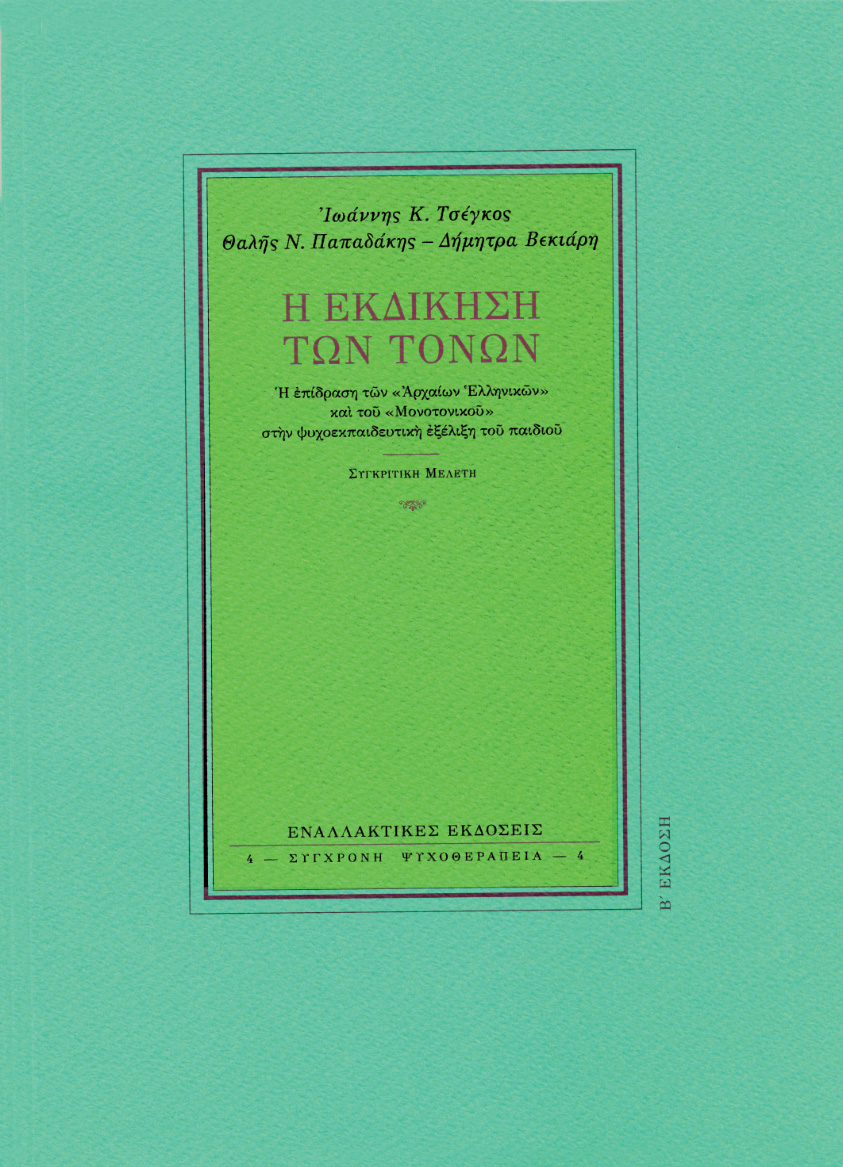
The Revenge of the Tones
The Revenge of Tones. The Influence of “Ancient Greek” and “Monotonic” on the Psychoeducational Development of the Child. I.K. Tsegos, T. N. Papadakis, D. Vekiari, 2005. Athens: Alternative Editions.
From the back cover:
After the deplorable quarrel in the Athens Philosophical Society over monotonicity during the Occupation (!), we had the publication of two books, The Trial of Tones (1943) and The Dispute of Tones (1944), by the corresponding factions. With this research, fortunately and “legally”, we have also reached the Revenge of the Tones, since after the Dictatorship that disrupted the Cleansing, the Post-Coalition period also disrupted the Elementary School!
The idea, the planning and the conduct of the research, on the consequences of the imposition of monotony, are the product of observations and reflections that were made not in the field of education, but in the field of health, when it was established that, apart from the fugitive correctors (“down with the bloodstained writings”), we now also have client-seeking therapists … as well as confirmation specialists for learning difficulties, dyslexia and “dyslexia”.
This research is, unfortunately, the first and only one that has been conducted in the 23 years that have passed since the midnight session of the Hellenic Parliament on January 11, 1982, when an irrelevant amendment imposed the abolition of tones and spirits.
The Training-Research Department of the Open Psychotherapy Centre conducted the present study from 1999 to 2002, the purpose of which was to investigate the possible impact of learning the historical orthography and the corresponding simplified script (monotonic) on the psychoeducational abilities and functions of the individual. 21 psychologists, 2 statisticians and one psychiatrist participated.
The findings lead to the conclusion that with the learning of ancient Greek – historical orthography, visual functions mature faster, as well as cognitive functions, such as Perception and Memory. That is, a positive effect was found on the visual-perceptual abilities and functions of children, from 6 to 9 years old, which this learning develops at an accelerated pace. And, as is known, the maturation of visual-perceptual and cognitive abilities and functions also entails further positive school performance.
This learning can act preventively in the appearance of certain learning difficulties (dyslexia, etc.), but also therapeutically, when these difficulties have already appeared.
CONTENTS
Acknowledgements
Ioannis K. Tsegos, Foreword
PART ONE: Preliminary review
Introduction (in the form of an interview)
PART TWO: The Research
The learning of ancient Greek as a beneficial factor in the psycho-educational development of the child
Introduction
A. Methodology
B. Conducting the research
C. The findings
D. Discussion
The problem of dyslexia
References – Bibliography
PART THREE
Appendix: Tables of Diagrams
Index of Subjects
Index of Names