
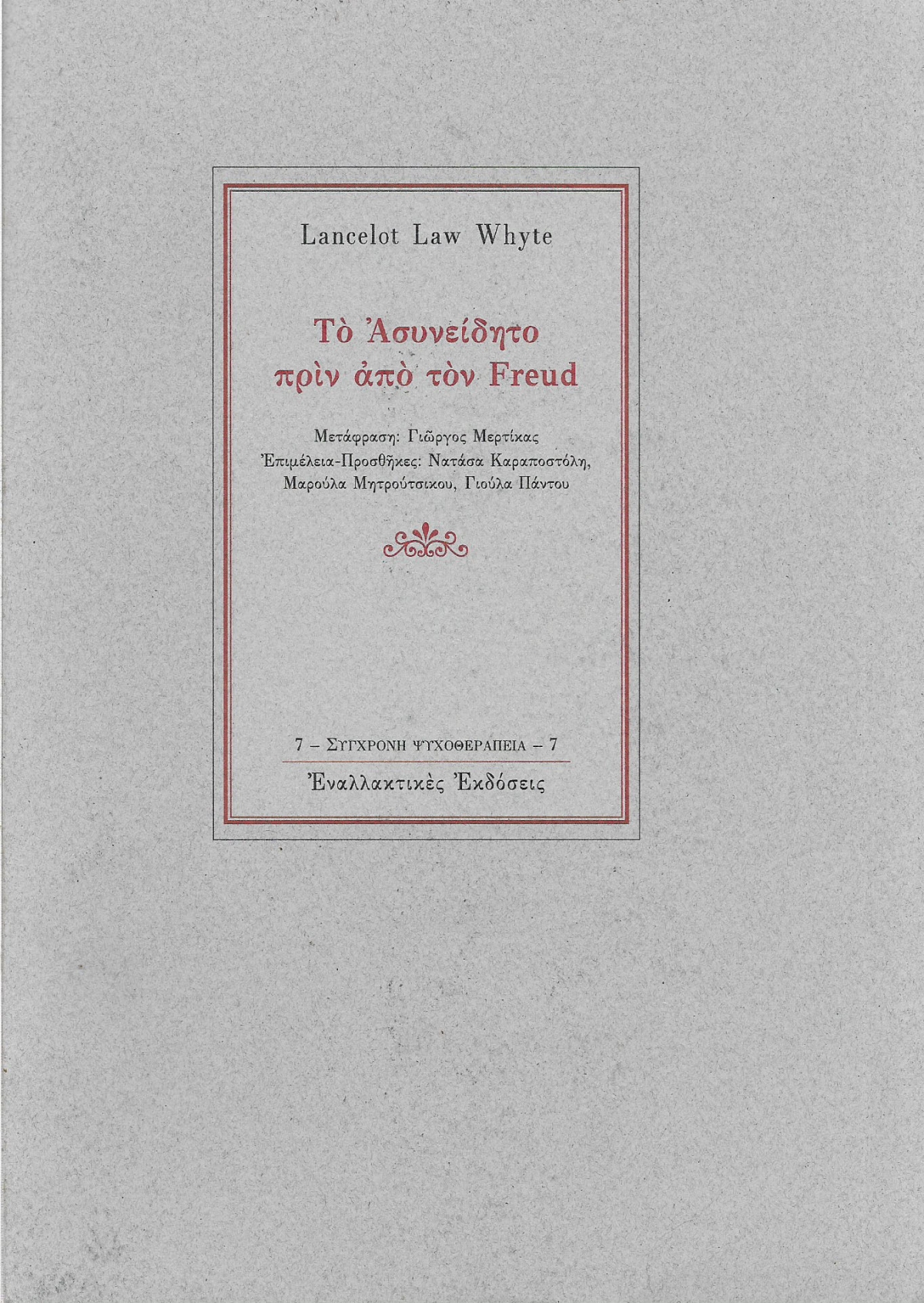
The Unconscious Before Freud
The Unconscious Before Freud, Whyte, L.L. (1960). Translation: Giorgos Mertikas. Edited by: Natasa Karapostoli, Maroula Mitroutsikou, Giula Pantou. Athens: Alternative Editions, 2009.
The idea of unconscious mental processes was, in many ways, understandable around 1700, relevant around 1800 and effective around 1900.
From the back cover:
… As is well known, Freud explained that he avoided reading Schopenhauer and Nietzsche until the end of his life because, as he said, “advancement interested me less than maintaining my impartiality”…
… “Freud did not really believe in the unconscious”; essentially, it was not to his liking, as was the libido or free imagination. For, according to his biographer, he spent most of his life fearing his own free imaginations, and sought security in a rigid morality, in a simplistic rationality, in a strict materialistic physiology, and in a psychology based on the attempt to eliminate complexity… He considered that the benefits of psychoanalysis, as a rule, were not complete or definitive for the neurotic individual or even for the analysand analyst, and its techniques have not yet led to significant discoveries that would improve and expand them.
… Freud’s limitations, as a person or as a thinker, were perhaps inevitable – they were certainly fruitful. However, the limitations of the profession are inexcusable..! The uncritical devotion to Freud by one school, during the period 1935-1945, was as foolish as the contempt for him by another, during the period 1905-1915.
… Criticism is a duty to genius. Freud’s greatness and lasting influence are here taken for granted. Yet his originality, in some respects, was less than he or others had imagined. Every generation exaggerates the achievements of the heroes it has produced. Worthy disciples of great men are those who seek to lessen any harm they may have done by showing where their ideas were inadequate or erroneous.
L.L. WHYTE